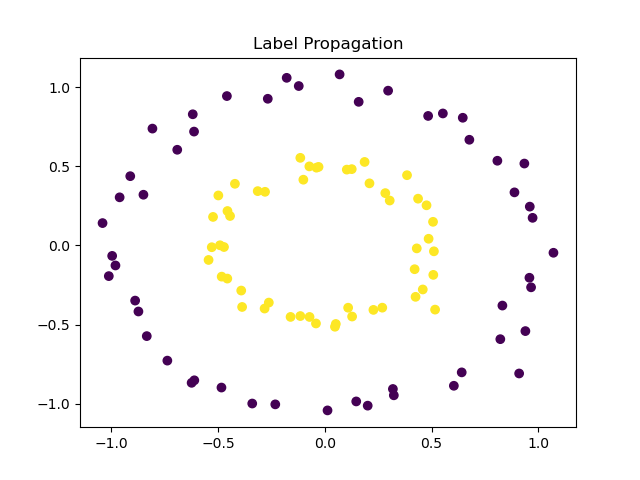
Label propagation
The label propagation algorithm is a method used in machine learning for assigning labels to unlabeled data based on the labels of neighboring data points. It can be thought of as a way to "propagate" or spread labels from labeled data to unlabeled data, leveraging the underlying relationships between them.
Here's a simplified explanation of the label propagation algorithm:
1. Imagine you have a set of data points, some of which are labeled with specific categories or classes, while others are unlabeled.
2. The algorithm starts by assigning the labeled data points their corresponding labels. These labeled data points act as "seeds" for the propagation process.
3. The algorithm then iteratively propagates labels from labeled data points to unlabeled data points based on their similarity or proximity to each other. In other words, if two data points are similar or close to each other, they are likely to belong to the same class.
4. During each iteration, the algorithm updates the labels of the unlabeled data points by considering the labels of their neighboring data points. The influence of each neighboring point is weighted based on their similarity to the target data point.
5. The propagation process continues for several iterations until a convergence criterion is met. This criterion is usually based on the stability of the label assignments or the number of iterations.
6. Once the algorithm converges, all the unlabeled data points will have been assigned labels based on the labels of their neighbors. This means that the algorithm has effectively "propagated" the labels from the labeled data to the unlabeled data.
Overall, the label propagation algorithm is a semi-supervised learning technique that takes advantage of the relationships between data points to infer labels for unlabeled data. It can be particularly useful when there is limited labeled data available, as it leverages the unlabeled data to improve the label assignments.