Overfitting
Overfitting is a phenomenon that occurs when a neural network is excessively trained on a particular dataset to the extent that it starts to perform poorly on new, unseen data. In other words, the network becomes too specialized and fails to generalize well beyond the training examples.
During the training process, a neural network aims to learn patterns, relationships, and representations in the training data that allow it to make accurate predictions or classifications. However, if the network becomes too complex or is trained for too long, it can begin to memorize the training examples instead of learning the underlying patterns and concepts.
Overfitting typically happens when the network has too many parameters relative to the amount of training data available, or when the training process continues for an excessive number of iterations. As a result, the network becomes overly sensitive to noise or random fluctuations in the training data, making it less capable of making accurate predictions on new, unseen data.
Signs of overfitting can include:
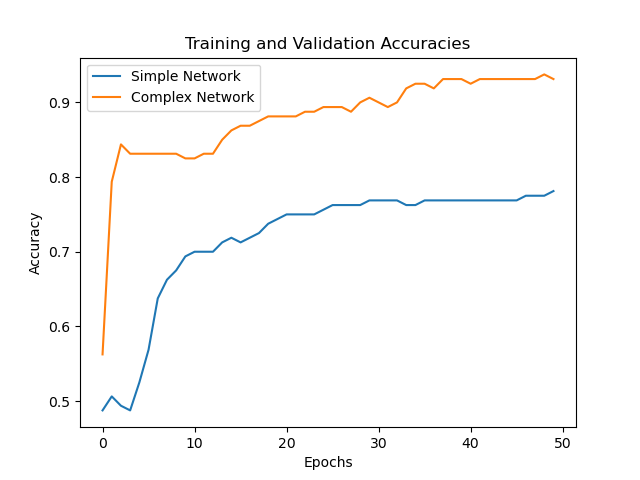
1. High training accuracy but low validation accuracy: The network performs very well on the training data but fails to generalize to new data.
2. Large differences between training and validation performance: The network shows a significant gap in performance between the training and validation datasets, indicating that it is not generalizing well.
To mitigate overfitting, various techniques can be employed:
1. Regularization: This involves adding a regularization term to the loss function during training, such as L1 or L2 regularization, which encourages the network to have smaller weights and prevents it from becoming too complex.
2. Early stopping: Training can be halted when the performance on the validation set starts to degrade, rather than continuing until the network achieves perfect training accuracy.
3. Data augmentation: Increasing the size and diversity of the training data through techniques like rotation, translation, scaling, or adding noise can help the network learn more robust and generalizable representations.
4. Dropout: Randomly disabling a fraction of the network's neurons during each training iteration can prevent co-adaptation of neurons and improve generalization.
5. Cross-validation: Splitting the available data into multiple subsets and performing multiple train-validation splits helps to assess the model's performance more robustly and identify potential overfitting.
By applying these techniques, it is possible to strike a balance between fitting the training data well and ensuring good generalization to unseen data, thereby reducing the risk of overfitting in neural networks.